
1,5-Hexadiene Market Overview
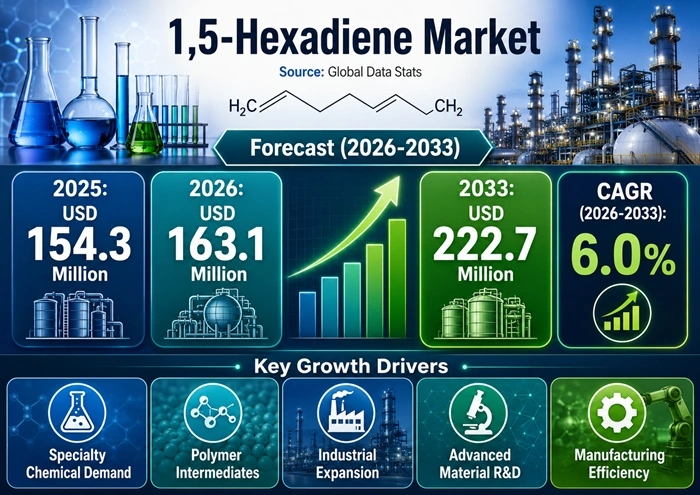
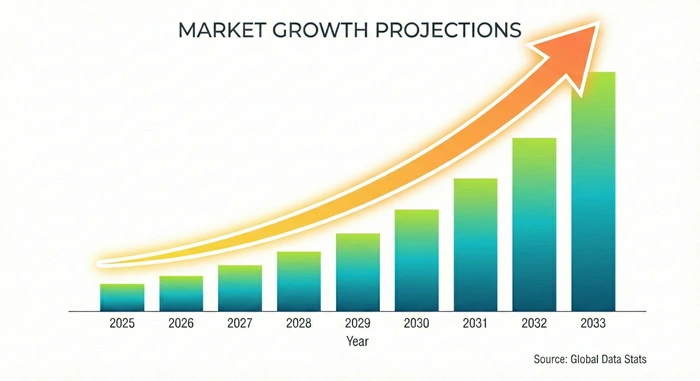
The global 1,5-Hexadiene market size is valued at USD 154.3 million in 2025 and is predicted to increase from USD 163.1 million in 2026 to approximately USD 222.7 million by 2033, growing at a CAGR of 6.0% from 2026 to 2033. The market is primarily driven by growing industrial demand for high-performance elastomers, rapid advances in organometallic chemistry, increasing use of specialty polymers across automotive and construction sectors, and rising pharmaceutical applications for complex chemical synthesis.
AI Impact on the 1,5-Hexadiene Industry
Artificial Intelligence Is Quietly Rewriting the Rules of Specialty Chemical Production — From Reaction Optimization to Predictive Supply Chain Management*
Artificial intelligence is making a notable impact across the specialty chemicals landscape, and the 1,5-hexadiene industry is no exception. AI-powered systems are being deployed by chemical manufacturers to fine-tune reaction conditions during polymerization, reduce material waste in production lines, and deliver consistent product quality at scale. These tools allow producers to monitor critical process parameters in real time, catching deviations before they lead to costly batch failures or purity inconsistencies. As a result, manufacturers are not only improving yield efficiency but also reducing operational overhead, enabling them to stay competitive in a market where purity standards continue to rise.
Beyond manufacturing optimization, artificial intelligence is accelerating research and development activities involving 1,5-hexadiene as a monomer and crosslinking intermediate. Pharmaceutical companies and advanced materials researchers are using AI-driven molecular modeling to identify new synthesis pathways and design novel polymer architectures with enhanced thermal and mechanical properties. Supply chain tools powered by machine learning are helping distributors and traders forecast demand more accurately, reducing lead time bottlenecks that have historically plagued specialty chemical procurement. This technological convergence is expected to further strengthen market growth through the forecast period, particularly in high-value application segments such as pharmaceutical intermediates and advanced elastomers.
Growth Factors
Rising Demand for Synthetic Rubber and High-Performance Polymers Is Fueling Long-Term Market Momentum Across Multiple End-Use Sectors
The primary force driving the 1,5-hexadiene market is the expanding global demand for synthetic rubber, especially ethylene propylene diene monomer (EPDM) rubber. As an acyclic diene, 1,5-hexadiene serves as a crucial termonomer and crosslinking agent in EPDM production, making it indispensable for manufacturing automotive seals, weather stripping, hoses, and anti-vibration components. The automotive sector alone accounts for a significant portion of EPDM consumption globally, and as vehicle production continues to climb — particularly in Asia Pacific and North America — the demand for quality crosslinking agents like 1,5-hexadiene is expected to grow proportionally.
On the industrial side, the construction sector has emerged as another strong demand driver. Synthetic rubbers and specialty polymers incorporating 1,5-hexadiene are widely used in flexible insulation, coatings, and adhesive formulations that require high durability and resistance to heat and moisture. Additionally, rapid advancements in organometallic chemistry and polyolefin synthesis are opening new avenues for the chemical's use as a co-monomer in precision polymer design. The expansion of pharmaceutical manufacturing, especially in emerging economies, is also contributing to market momentum as 1,5-hexadiene serves as a key building block in complex drug molecule synthesis. Together, these factors create a robust and diversified growth foundation for the market through 2033.
Market Outlook
Strong Fundamentals, Rising Industrialization, and Expanding End-Use Applications Position the 1,5-Hexadiene Market for Sustained Growth Through 2033
The 1,5-hexadiene market presents a strong and balanced growth outlook from 2026 to 2033, supported by steady industrial expansion across key geographies and a diversification of application areas. Asia Pacific is expected to remain the fastest-growing region, driven by large-scale chemical manufacturing investments in China and India, combined with surging automotive and construction activity. North America, backed by a well-established petrochemical base and strong polymer R&D infrastructure, is expected to maintain its position as a key revenue contributor. European markets, while more mature, continue to benefit from strict quality standards that favor high-purity grades of 1,5-hexadiene for specialty applications.
Looking ahead, the transition toward electric vehicles (EVs) adds an important layer of growth potential for the market. EV manufacturers require lightweight, durable materials with high thermal resistance — properties that elastomers derived from EPDM rubber offer in abundance. As a critical precursor in EPDM synthesis, 1,5-hexadiene stands to benefit directly from the accelerating EV adoption trend. Furthermore, growing investments in pharmaceutical R&D and the increasing use of specialty chemical intermediates in API manufacturing are expected to support high-margin application segments. Market participants who focus on product purity enhancement, sustainable production practices, and digital supply chain capabilities will be well positioned to capture emerging opportunities.
Expert Speaks
-
"The specialty chemicals sector is entering a new era driven by performance materials and sustainable innovation — companies that invest in high-purity intermediates and advanced polymer technologies will define the competitive landscape for the next decade," — Fisk Johnson, Chairman & CEO, SC Johnson, emphasizing the long-term value of specialty chemical investment.
-
"As we accelerate our electric vehicle transition, demand for durable, thermally resistant elastomers and polymer systems is rising sharply — securing the right chemical intermediates across the supply chain is now a strategic priority," — Jim Farley, President & CEO, Ford Motor Company, highlighting the material supply chain importance for EV manufacturing.
-
"Advancing our pharmaceutical pipeline requires reliable, high-quality chemical building blocks — and the growing availability of specialty monomers and diene intermediates is enabling faster drug development timelines," — Albert Bourla, Chairman & CEO, Pfizer, underscoring the role of specialty chemical intermediates in pharmaceutical R&D.
Key Report Takeaways
-
Asia Pacific leads the global market with a dominant share of approximately 34% in 2025, propelled by China's large-scale chemical manufacturing capacity, India's growing pharmaceutical sector, and rapidly expanding automotive production across the region
-
Asia Pacific is also the fastest-growing region, expected to expand at a CAGR of around 7.2% through the forecast period, making it the most dynamic geography for market participants looking to scale operations
-
The chemical industry end-use segment contributes the most to overall market revenue, commanding approximately 48% share in 2025, driven by the widespread use of 1,5-hexadiene as a polymerization intermediate and specialty chemical precursor
-
The specialty chemicals application segment leads among application categories with a 33% share in 2025, reflecting increasing investments in high-value chemical formulations and industrial chemical innovation
-
The 95%–98% purity segment is the most popular, holding the largest purity segment share of 47% in 2025, as it offers an optimal balance between cost efficiency and quality performance for polymer and elastomer production
-
The pharmaceutical intermediates application segment is the fastest growing, with a projected CAGR of approximately 6.8% through 2033, fueled by growing drug pipelines, increasing API manufacturing investments, and expanding use of high-purity diene compounds in complex molecule synthesis; this segment currently holds an 11% share and is expected to increase its contribution significantly by the end of the forecast period
Market Scope
| Report Coverage | Details |
|---|---|
| Market Size by 2025 | USD 154.3 Million |
| Market Size by 2026 | USD 163.1 Million |
| Market Size by 2033 | USD 222.7 Million |
| Market Growth Rate from 2026 to 2033 | CAGR of 6.0% |
| Dominating Region | Asia Pacific |
| Fastest Growing Region | Asia Pacific |
| Base Year | 2025 |
| Forecast Period | 2026 to 2033 |
| Segments Covered | By Purity, By Application, By End-Use Industry, By Distribution Channel, By Region |
| Regions Covered | North America, Europe, Asia Pacific, Latin America, Middle East & Africa |
Market Dynamics
Drivers Impact Analysis
Strong Industrial Tailwinds and Rising Polymer Demand Are Creating Measurable Upward Pressure on the 1,5-Hexadiene Market's Long-Term Growth Trajectory
| Driver | ≈ % Impact on CAGR Forecast | Geographic Relevance | Impact Timeline |
|---|---|---|---|
| Growing Demand for Synthetic Rubber (EPDM) | ~2.1% | Global, primarily Asia Pacific & North America | Near to Long Term |
| Expansion of Automotive & EV Manufacturing | ~1.5% | Asia Pacific, North America, Europe | Medium to Long Term |
| Rising Pharmaceutical Intermediate Applications | ~1.2% | Asia Pacific, North America | Medium to Long Term |
| Advances in Organometallic Chemistry | ~0.7% | North America, Europe | Long Term |
| Growing Construction Sector Demand | ~0.5% | Asia Pacific, MEA, Latin America | Near to Medium Term |
The growing demand for synthetic rubber stands as the most influential driver in the 1,5-hexadiene market. As EPDM rubber continues to be the material of choice for temperature-resistant and flexible automotive parts, construction sealants, and industrial gaskets, manufacturers are increasing their procurement of 1,5-hexadiene as a reliable crosslinking termonomer. The rising global vehicle fleet, combined with strict performance standards for automotive sealing materials, is making EPDM indispensable, which in turn sustains strong and consistent demand for 1,5-hexadiene across major producing regions.
The automotive sector's pivot toward electric vehicles represents an equally significant demand catalyst. EVs require specialized elastomers and lightweight polymer systems that can withstand high operating temperatures, resist chemical exposure, and maintain durability over extended vehicle lifecycles. 1,5-hexadiene-derived EPDM compounds meet these technical specifications, positioning the material as a critical input in next-generation vehicle manufacturing programs. With EV production accelerating across China, the United States, and Europe, the demand signal for high-purity 1,5-hexadiene is expected to remain strong and grow consistently through the forecast period.
Restraints Impact Analysis
Petrochemical Price Volatility and Stringent Regulatory Frameworks Remain Significant Barriers Limiting the Wider Adoption and Production of 1,5-Hexadiene
| Restraint | ≈ % Impact on CAGR Forecast | Geographic Relevance | Impact Timeline |
|---|---|---|---|
| Fluctuations in Petrochemical Feedstock Prices | ~-1.2% | Global | Near to Medium Term |
| Stringent Safety & Environmental Regulations | ~-0.8% | Europe, North America | Near to Long Term |
| High Production & Storage Compliance Costs | ~-0.5% | Global | Medium Term |
| Limited Availability of Raw Material Suppliers | ~-0.3% | MEA, Latin America | Medium Term |
Volatility in petrochemical feedstock prices is the most significant restraint in the 1,5-hexadiene market. Because this chemical is derived from petroleum-based precursors, any sharp movement in crude oil prices directly influences production costs and profit margins. Manufacturers operating on thin margins in competitive specialty chemical markets are particularly vulnerable to such price swings, which can reduce investment in capacity expansion and new product development. This unpredictability creates planning challenges across the supply chain, particularly for buyers who operate under long-term supply contracts.
Regulatory pressure related to safety and environmental compliance adds another layer of constraint for producers and distributors. 1,5-hexadiene is a highly flammable, volatile compound that requires rigorous handling, storage, and transportation protocols. Compliance with REACH regulations in Europe, EPA guidelines in North America, and various national chemical safety standards requires substantial investment in specialized infrastructure. Smaller producers, in particular, may find it challenging to absorb these compliance costs while maintaining price competitiveness, which could limit market participation and slow production capacity expansion in certain geographies.
Opportunities Impact Analysis
The EV Revolution and Expanding Pharmaceutical R&D Are Creating High-Value Market Opportunities for 1,5-Hexadiene Producers and Distributors
| Opportunity | ≈ % Impact on CAGR Forecast | Geographic Relevance | Impact Timeline |
|---|---|---|---|
| EV-Driven Demand for High-Performance Elastomers | ~+1.8% | Asia Pacific, North America, Europe | Medium to Long Term |
| Growth in Pharmaceutical Intermediate Applications | ~+1.3% | Asia Pacific, North America | Medium to Long Term |
| Expansion of Specialty Chemical Formulations | ~+1.0% | Global | Near to Long Term |
| B2B E-Commerce Channels for Chemical Distribution | ~+0.6% | Asia Pacific, North America | Near Term |
The rapid growth of the electric vehicle segment creates a major commercial opportunity for the 1,5-hexadiene market. As automakers ramp up EV production, the need for custom-formulated elastomers — including those based on EPDM chemistry — is increasing across the supply chain. This demand extends to OEM suppliers, tier-1 component manufacturers, and specialty polymer producers, all of whom require consistent access to high-quality crosslinking agents like 1,5-hexadiene. Companies that invest in capacity expansion and purity enhancement are well-positioned to capitalize on this structural demand shift.
The pharmaceutical and biotechnology sector offers another compelling growth avenue. As drug discovery pipelines become more complex and molecular precision becomes more critical, pharmaceutical manufacturers are turning to high-purity specialty chemical intermediates — including 1,5-hexadiene derivatives — to synthesize intricate active pharmaceutical ingredients (APIs). The growing emphasis on developing next-generation biologics, targeted small molecules, and complex synthetic compounds is creating sustained demand for ultra-pure diene intermediates. This shift toward higher-value end uses also supports improved pricing power for producers, contributing positively to overall market economics through 2033.
Segment Analysis
By Purity
The 95%–98% Purity Grade Continues to Dominate, While Ultra-High Purity Grades Are Rapidly Gaining Ground in Pharmaceutical and Advanced Materials Applications
The 95%–98% purity segment holds the largest share of the 1,5-hexadiene market, accounting for approximately 47% in 2025 and generating around USD 72.5 million in revenue. This segment benefits from its widespread use as a cost-effective yet high-quality crosslinking agent and comonomer in the production of specialty polymers and synthetic rubbers. It provides manufacturers with precise molecular control and consistent polymerization behavior without the premium cost associated with ultra-high purity grades. The segment is particularly dominant in North America and Europe, where established chemical companies such as Chevron Phillips Chemical and INEOS use this grade extensively in their elastomer manufacturing operations. It is expected to grow at a CAGR of approximately 5.5% through 2033.
The above 98% purity segment is the fastest-growing purity category, projected to expand at a CAGR of around 7.0% through the forecast period. This segment, which held approximately 35% market share in 2025, is driven primarily by demand from pharmaceutical manufacturers and advanced materials researchers who require precise molecular structures and minimal impurity levels. Asia Pacific, led by China, is emerging as the most dynamic growth region for this segment, as domestic pharmaceutical companies scale up API production and specialty polymer manufacturers compete for high-end application contracts. Global companies such as Tokyo Chemical Industry and Merck KGaA are key suppliers serving this ultra-pure segment, leveraging advanced distillation and purification technologies to meet stringent quality requirements.
By Application
Specialty Chemicals Lead in Revenue Contribution, While Pharmaceutical Intermediates Emerge as the Most Promising Application Growth Category for 1,5-Hexadiene
The specialty chemicals application segment dominates the 1,5-hexadiene market with a 33% revenue share in 2025, generating approximately USD 50.9 million. This segment benefits from growing industrial investment in high-value chemical formulations and the increasing replacement of commodity chemicals with precision specialty intermediates. North America and Europe are the key revenue-generating regions for this application, supported by the presence of advanced chemical processing infrastructure and strong R&D ecosystems. Key players such as BASF, Evonik Industries, and LyondellBasell Industries are actively deploying 1,5-hexadiene in specialty chemical manufacturing programs, further strengthening segment dominance. The specialty chemicals application category is projected to grow at a CAGR of 6.2% through 2033.
The polymer production application segment represents the second-largest contributor with approximately 27% market share in 2025. This segment is driven by the rapid expansion of elastomer manufacturing, rising automotive polymer consumption, and the growing use of lightweight industrial plastics in construction and electronics. 1,5-hexadiene plays a critical role as a cross-linking co-monomer in polyolefin synthesis, enabling the creation of materials with superior flexibility, thermal resistance, and chemical stability. Asia Pacific is the fastest-growing region for this application, fueled by a booming automotive sector and large-scale chemical manufacturing investments in China and India. This segment is expected to expand at a CAGR of around 6.5% through the forecast period.
Regional Insights
North America
North America's Robust Petrochemical Infrastructure and Strong Automotive Polymer Demand Continue to Anchor Its Position as a Major Revenue-Generating Region
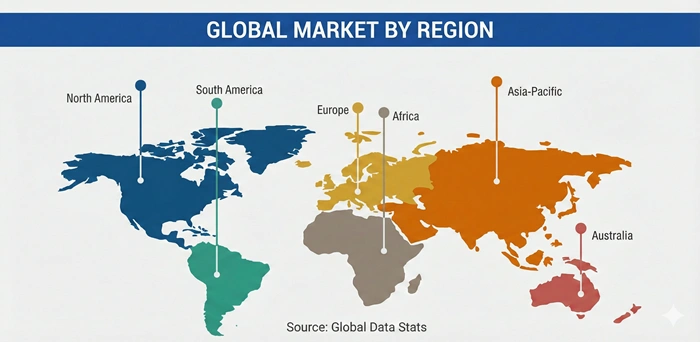
North America held a market share of approximately 31% in 2025 and is expected to grow at a CAGR of 5.1% through 2033. The region benefits from a well-developed petrochemical base, strong polymer manufacturing capabilities, and significant investment in R&D for advanced specialty chemicals. The United States, which commands the largest share within the region, is home to major market participants such as Chevron Phillips Chemical and TPC Group, who actively use 1,5-hexadiene as a key input in high-performance elastomer programs. The growing shift toward electric vehicle manufacturing in the U.S. is creating additional demand for thermally stable synthetic rubber materials, adding a new and sustained demand layer for 1,5-hexadiene derivatives.
Canada and Mexico contribute meaningfully to the regional picture as well, with Mexico's expanding automotive component manufacturing sector increasing consumption of specialty elastomers. The U.S. pharmaceutical industry's scale and complexity further support demand for high-purity 1,5-hexadiene intermediates, and ongoing investments in domestic API manufacturing infrastructure suggest this demand stream will strengthen over the forecast period. With companies like Thermo Fisher Scientific and Sigma-Aldrich supplying high-purity grades for pharmaceutical and research applications, North America maintains a strong multi-sector demand foundation that underpins consistent market growth.
Asia Pacific
Asia Pacific Leads Global Market Share and Growth Rate Simultaneously — a Rare Convergence Driven by Massive Industrial Expansion and Diversified End-Use Demand
Asia Pacific dominates the 1,5-hexadiene market with the largest regional share of 34% in 2025 and is projected to grow at the fastest CAGR of approximately 7.2% through 2033. China is the region's primary growth engine, driven by its large-scale chemical manufacturing base, low production costs, and a booming automotive sector that demands high-performance elastomers. Chinese chemical companies have been ramping up production of EPDM-based synthetic rubbers, making 1,5-hexadiene a consistently high-demand commodity in the domestic supply chain. India, South Korea, and Japan contribute additional demand from pharmaceutical manufacturing and advanced materials research, further diversifying the region's consumption base.
Key players operating across Asia Pacific include Shanghai Jinhong Chemical, HUBEI JINGHONG CHEMICAL, and Yi BANG, who cater primarily to domestic polymer and pharmaceutical customers. South Korea's electronics and specialty materials sector represents an emerging demand channel, as manufacturers increasingly explore diene-based materials for flexible electronics and thermal interface applications. The region also benefits from growing government support for chemical industry modernization and domestic capacity expansion, which is reducing reliance on imports and improving the availability of locally produced 1,5-hexadiene. These converging factors make Asia Pacific the most strategically significant geography for market participants planning long-term investment decisions.
Report Customization: Region-Wise and Country-Wise Insights Available on Request
This Report Can Be Tailored to Deliver Precise Market Intelligence for Every Region and Country Where the 1,5-Hexadiene Market Operates — Ensuring That Decision-Makers Receive Locally Relevant, Actionable Data
Customized versions of this report are available for each region and country listed below. Each customized report provides in-depth market analysis, local demand trends, competitive landscape, regulatory environment, growth opportunities, and forecast data specifically tailored for the selected geography and the 1,5-hexadiene market.
North America
-
U.S. — detailed analysis of petrochemical infrastructure, polymer manufacturing demand, and pharmaceutical intermediate use cases
-
Canada — insights into specialty chemical production capacity and cross-border trade dynamics
-
Mexico — automotive component manufacturing sector's growing role in EPDM and elastomer consumption
Europe
-
U.K. — advanced polymer research and specialty chemical formulation landscape
-
Germany — automotive industry-driven elastomer demand and high-purity chemical synthesis activity
-
France — pharmaceutical and fine chemicals sector analysis
-
Italy — specialty coating and adhesive applications
-
Rest of Europe — regional growth patterns, regulatory compliance developments, and emerging market opportunities
Asia Pacific
-
China — large-scale chemical manufacturing, EPDM demand, and domestic supply chain expansion
-
India — pharmaceutical intermediate manufacturing and growing specialty chemical production
-
Japan — advanced materials and electronics-grade specialty chemical demand
-
South Korea — polymer and flexible electronics applications
-
Australia — mining and industrial chemical applications
-
Rest of Asia Pacific — emerging consumption zones and investment trends
Latin America
-
Brazil — agrochemical and industrial intermediate demand insights
-
Argentina — specialty chemicals and polymer manufacturing landscape
-
Rest of Latin America — regional expansion dynamics and supply chain opportunities
Middle East & Africa
-
UAE — petrochemical diversification, pharmaceutical sector growth, and downstream chemical expansion
-
Saudi Arabia — ARAMCO-linked petrochemical industry and specialty chemical investment
-
Rest of MEA — emerging market demand, infrastructure development, and import-export trends
Top Key Players
-
Chevron Phillips Chemical (United States)
-
INEOS (United Kingdom)
-
LyondellBasell Industries (Netherlands)
-
SABIC (Saudi Arabia)
-
BASF (Germany)
-
Evonik Industries (Germany)
-
Shell Chemicals (Netherlands)
-
Wacker Chemie (Germany)
-
TPC Group (United States)
-
Merck KGaA (Germany)
-
Tokyo Chemical Industry (Japan)
-
Thermo Fisher Scientific (United States)
-
Alfa Aesar (United States)
-
Sigma-Aldrich (United States)
-
Santa Cruz Biotechnology (United States)
Recent Developments
-
In August 2025, a research team published findings on a hafnium-catalyzed polymerization strategy for 1,5-hexadiene, resulting in advanced graft copolymers that significantly improve the toughness of poly(lactic acid) — achieving up to a 30-fold increase in elongation at break, marking a significant step in biodegradable polymer development.
-
In 2025, Chevron Phillips Chemical advanced its alpha olefins expansion program, focusing on increasing capacity for specialty diene and hexene-based intermediates to meet growing downstream demand from elastomer manufacturers in North America and Asia Pacific.
-
In 2024, Evonik Industries announced expanded investments in specialty monomer production capabilities at its European facilities, with a focus on high-purity grades suited for pharmaceutical intermediate and advanced polymer applications.
-
In 2024, BASF strengthened its specialty chemicals portfolio through targeted R&D collaborations with automotive materials suppliers, including work on diene-based crosslinking systems for next-generation EV component elastomers.
-
In 2025, Tokyo Chemical Industry expanded its catalog of high-purity organics, including 1,5-hexadiene above 98% purity, targeting pharmaceutical synthesis and specialty polymer research customers in Asia Pacific and North America.
Market Trends
Digital Transformation, Sustainability Priorities, and Purity Upgrade Trends Are Reshaping the Competitive Landscape of the 1,5-Hexadiene Market
One of the most prominent market trends shaping the 1,5-hexadiene industry is the push toward higher-purity grades across end-use sectors. As pharmaceutical manufacturers raise quality benchmarks for API synthesis and polymer producers shift toward precision material design, demand is increasingly concentrated in the 95%–98% and above 98% purity tiers. This trend is encouraging producers to invest in advanced purification technologies, tighter quality control systems, and more rigorous supply chain documentation — raising the barrier to entry and rewarding established, well-capitalized players who can consistently meet elevated specifications.
Simultaneously, the rise of B2B digital platforms and online chemical marketplaces is reshaping how 1,5-hexadiene is sourced and distributed. While direct sales channels still dominate with a 58% market share, the online sales segment is growing at the fastest rate among all distribution channels, driven by increasing digital fluency among procurement teams and the convenience of real-time pricing and specification comparison. This channel shift is opening new competitive dynamics, allowing smaller specialty suppliers to reach global buyers and enabling manufacturers to bypass traditional distributor networks in favor of direct digital relationships. Companies that invest in digital distribution infrastructure and transparent data-sharing systems will gain a meaningful competitive advantage as this trend accelerates.
Segments Covered in the Report
By Purity
-
Below 95%
-
95%–98%
-
Above 98%
By Application
-
Specialty Chemicals
-
Polymer Production
-
Adhesives & Sealants
-
Pharmaceutical Intermediates
-
Research & Laboratory Use
-
Others
By End-Use Industry
-
Chemical Industry
-
Pharmaceutical Industry
-
Automotive Industry
-
Electronics Industry
-
Research Institutes & Laboratories
-
Others
By Distribution Channel
-
Direct Sales
-
Distributors & Traders
-
Online Sales
By Region
-
North America (U.S., Canada, Mexico)
-
Europe (U.K., Germany, France, Italy, Rest of Europe)
-
Asia Pacific (China, India, Japan, South Korea, Australia, Rest of Asia Pacific)
-
Latin America (Brazil, Argentina, Rest of Latin America)
-
Middle East & Africa (UAE, Saudi Arabia, Rest of MEA)
❝ Built for Every Level — From Startups to Industry Giants ❞
Here Is Exactly How This Report Works for You
-
For Tier 1 multinationals and high-level corporations, this report delivers a full competitive revenue analysis — including competitor revenue sources, market share positioning, and how geopolitical factors such as trade policies, regional regulations, and supply chain disruptions are impacting sourcing decisions, pricing strategies, and long-term investment planning in the 1,5-hexadiene sector.
-
For Tier 2, Tier 3 companies, mid-level businesses, and startups, this report maps out supply-demand dynamics in granular detail, identifying where demand is outpacing supply, which geographies offer the lowest barriers to entry, and how emerging application segments like pharmaceutical intermediates and EV elastomers can be leveraged to establish a competitive foothold in this growing market.
-
For investors and financial stakeholders, this report provides a rigorous, data-backed forecast with CAGR analysis, segment-level growth projections, and a structured view of how market forces across purity tiers, distribution channels, and regional economies are converging to define the most profitable investment opportunities in the 1,5-hexadiene space through 2033.
Frequently Asked Questions
Question 1: What is the current market size of the 1,5-hexadiene market and where is it headed?
Answer: The 1,5-hexadiene market is valued at USD 154.3 million in 2025 and is projected to reach USD 222.7 million by 2033. The market is growing steadily at a CAGR of 6.0% between 2026 and 2033, driven by expanding applications in synthetic rubber, specialty chemicals, and pharmaceutical intermediates.
Question 2: Which region dominates the 1,5-hexadiene market and what drives its leadership?
Answer: Asia Pacific dominates the 1,5-hexadiene market with a 34% share in 2025, led by China's large-scale chemical and automotive manufacturing base. The region also holds the highest growth rate, making it the most strategically important geography in this market.
Question 3: What are the major applications of 1,5-hexadiene in industrial sectors?
Answer: The primary applications of 1,5-hexadiene include use as a crosslinking agent in EPDM synthetic rubber production, as a co-monomer in specialty chemical formulations, and as a pharmaceutical intermediate in complex API synthesis. Its role in polymer production and adhesive manufacturing also represents a significant share of overall demand.
Question 4: What challenges could limit the growth of the 1,5-hexadiene market?
Answer: Fluctuations in petrochemical feedstock prices are the most significant restraint, as this chemical is a petroleum-derived compound sensitive to crude oil market volatility. Additionally, stringent safety and environmental regulations related to its flammability and volatile nature increase compliance costs for producers and distributors.
Question 5: Which purity grade of 1,5-hexadiene is expected to grow the fastest in the coming years?
Answer: The above 98% purity grade is expected to grow at the fastest CAGR of approximately 7.0% through 2033, driven by rising pharmaceutical and advanced materials demand. This ultra-high purity grade of 1,5-hexadiene is increasingly preferred for precision polymer synthesis and pharmaceutical API manufacturing applications.